The Market Brief
U.S. futures cautiously higher higher during early trading after a wave of AI-driven selling swept through the market, hitting sectors well beyond technology.
Impact Snapshot
🟥 Consumer Confidence - 10:00am
Macro Viewpoint
Stocks edged higher after a wave of AI-driven selling swept through the market, hitting sectors well beyond technology.
The concern is straightforward: if AI compresses margins, automates workflows, or disrupts business models, the damage won’t be contained to software. We’ve seen the pressure extend to insurance brokers, private credit, cybersecurity, and real estate services, suggesting investors are repricing exposure fairly broadly.
This rotation is one of several undercurrents running through a US equity market that is roughly flat on the year, a notable contrast to the tech-led rallies that defined the prior few years.
Trade policy uncertainty has resurfaced, and geopolitical tensions between the US and Iran are rising. For systematic strategies, these overlapping risk factors create a challenging environment where correlations can shift quickly and traditional factor exposures may behave unexpectedly.
Prime Intelligence
One technical factor we’re monitoring closely is dealer gamma exposure, which has declined sharply toward zero after holding in a notably supportive +$4–9bn range for much of the past year.
Historically, elevated gamma regimes have coincided with a more "pinned" market dynamic: dips tend to be absorbed, ranges stay compressed, and realized volatility remains subdued. This occurs because dealers, who are typically long gamma, hedge by selling into rallies and buying dips, naturally dampening price swings.
When gamma collapses toward zero or turns negative, as seen in March–April 2025, that stabilizing flow reverses. Dealers must now hedge in the same direction as price moves, amplifying rather than absorbing them. The result: wider intraday ranges and air-pocket-style dislocations.
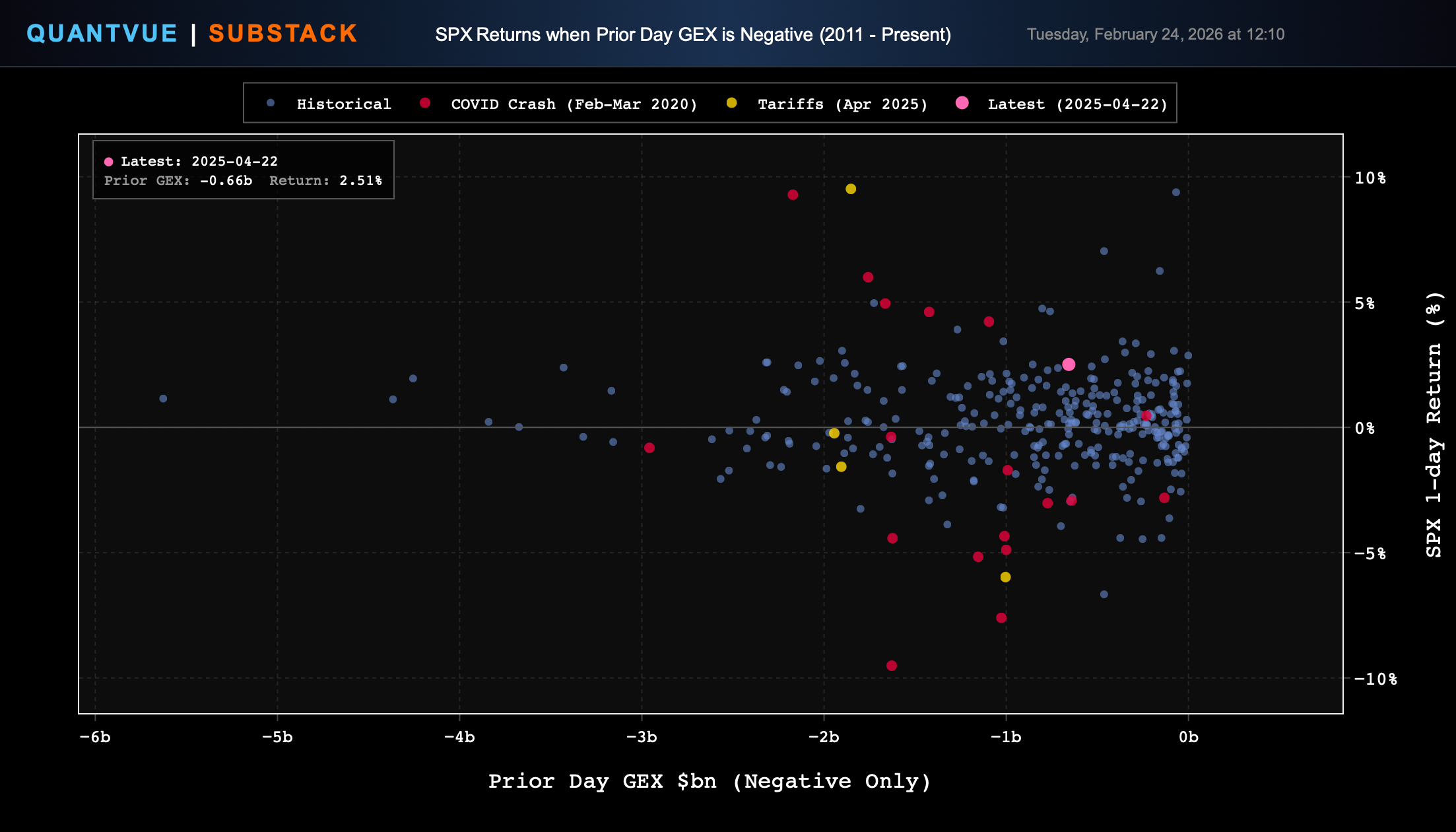
It's worth being precise about what this signal does and doesn't tell us. Low gamma carries no inherent directional bias. What it removes is a structural volatility dampener, meaning that when moves do occur, they tend to travel further and resolve more slowly.
The Market Brief
Our research is grounded in data-driven analysis rather than speculative fundamentals, which is central to how we anticipate regime shifts and calibrate expectations before the market opens. In today’s brief we cover:
How the NVDA 0.00%↑ print reshapes dealer gamma and regime conditions
Whether flows confirm rotation or a broader risk-off move
What the NDX vol term structure signals post-event
How we’re framing positioning and expectations in light of the outcome
This is a FREE edition of the Market Brief. To receive our additional in-depth research, consider becoming a paid subscriber.👇