The Market Brief
U.S. futures are cautiously higher in early Tuesday trading, recovering some ground after a selloff that has put the benchmark on track for its worst month since 2022.
Impact Snapshot
🟥 JOLTs Job Openings - 10:00am
Macro Viewpoint
U.S. futures gained Tuesday after reports that President Trump may be open to ending military operations against Iran, even with the Strait of Hormuz partially closed. The news offered meaningful relief after weeks of relentless selling pressure across global markets.
The S&P 500 and the Dow are on track for their worst monthly and quarterly declines since 2022, with risk assets broadly repricing as the conflict dragged on longer than markets anticipated.
The oil spike stemming from the conflict has reignited inflation concerns, with money markets now pricing out any Fed cuts this year. That is a significant shift from the two cuts expected before the war broke out.
Prime Intelligence
Historically, significant drawdowns come with a sharp rise in realized correlation, reflecting broader, more indiscriminate selling. That’s not what we’re seeing here.
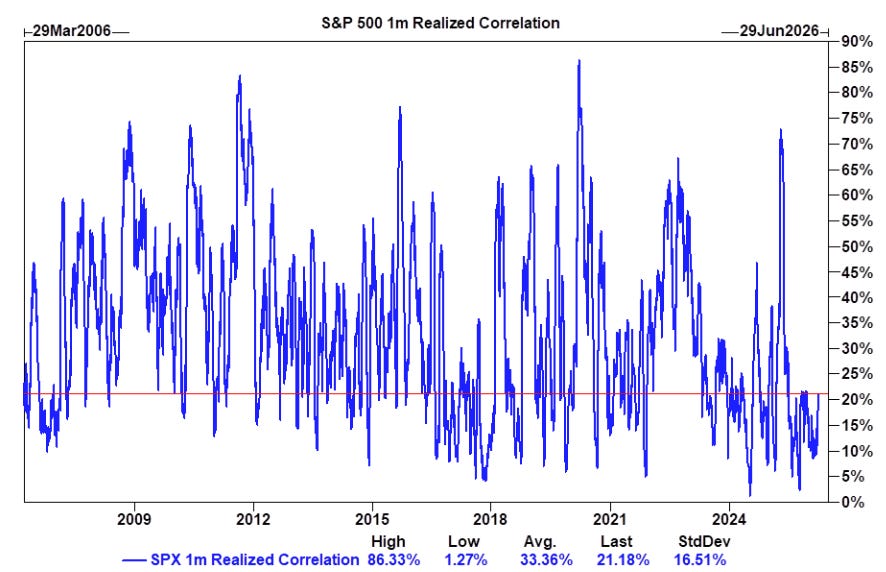
S&P 1-month realized correlation sits at roughly 20%, well below historical stress levels. This points to a narrow leadership unwind rather than broad-market liquidation. Breadth confirms the same picture. Only around 11% of S&P constituents are oversold, far short of levels typically associated with durable market bottoms.
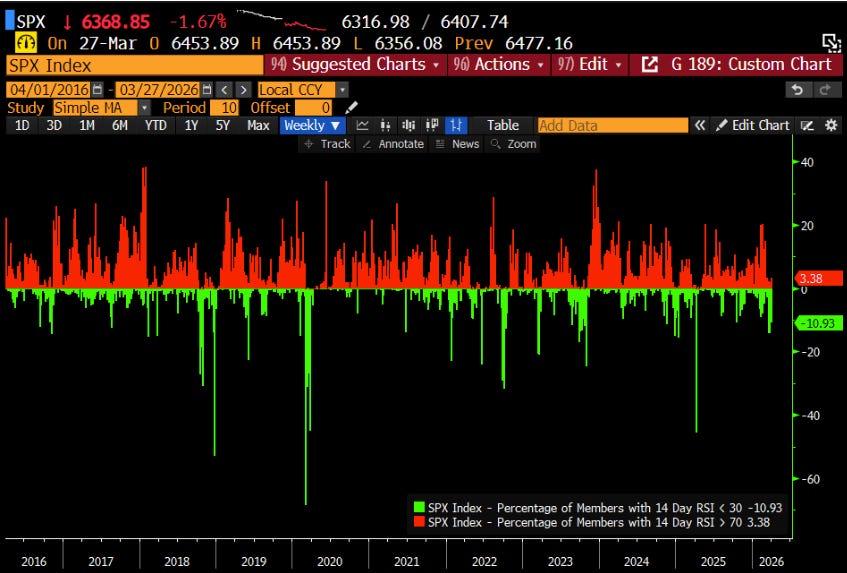
What makes this interesting is the disconnect in the options market. S&P 1-month implied correlation has moved into the 40s, roughly twice realized levels. That gap historically resolves one of two ways: realized volatility catches up, or implied volatility compresses and hedges bleed out.
So far, it’s been the latter. Short-dated options have underdelivered as a hedge. The S&P didn’t even realize last week’s implied move (2.8% implied vs. 2.1% actual), and long gamma strategies, a common institutional hedging approach, have continued to underperform in this environment.
The Market Brief
In today's brief we break down where positioning actually stands after weeks of selling, and why the next big move could catch most of the market completely off guard. Read the full article below.
Join hundreds of subscribers already on the inside.👇